
You and Your Brain 6: From a Calm Mind to Flipping Your Lid
Dear Friend,
Welcome to the week of Flipping Your Lid!

In our city, we’re nearing the last week of school.
Students are feeling a range of emotions.
Teachers are trying to keep them from bouncing off the walls.
Parents are scrambling for summer camp sign-ups or just looking forward to slower mornings.
The transition to summer is either about to happen or has already happened. Transitions can bring up emotions. Anger and fear are the easiest to access, so get ready! These emotions are effective. They protect us from change. Anger takes a stand and fights for what it wants. Fear is fiercely protective.
If “a calm mind” is hard to come by in the next few weeks, ask yourself or your students:
- What do you really want? What are you taking a stand for?
- What are you trying to fiercely protect?
As a parent, quiet time might be important to you. Summer changes that.
As a child, a dependable daily schedule might feel safe. Summer changes that.
When family members are getting used to a new schedule and are together more often in the home, it’s easy to lose your cool.
Here’s what happens when you flip your lid and how to get back to a calm state of mind.

Mindfulness Activity of the Week
From a Calm Mind to Flipping Your Lid
Your wrist represents your brainstem.
Your thumb represents your limbic system (including the amygdala-the most primordial part of your brain focused on survival.)
Your fingers represent your prefrontal cortex.
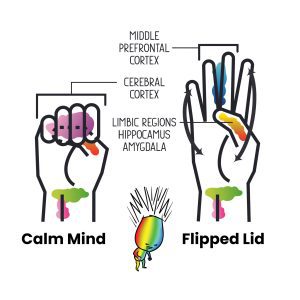
- Make a fist, then wrap your fingers over your thumb. When you are calm, this is your brain.
- Visualize a calm scene in your mind, like sitting on a beach, petting an animal, or watching a sunset.
- Breathe into your belly for a few rounds of breath.
- Notice how your limbic system is protected and safely tucked away underneath your prefrontal cortex.
- When the amygdala (your thumb) sends out an alert about a posed threat, your brainstem (wrist) increases your heartbeat and breath rate, and your prefrontal cortex (fingers) stands at attention, getting ready to fight, flee, or freeze.
- What do you notice after reading the last sentence? Has your heart rate increased?
- If the posed threat worsens, you lose all connection to rational thought, your ability to communicate, and reason. You start to rely solely on your limbic system for safety and security.
- Only after a few long, slow, deep breaths can you return to a more regulated or rational state of mind.
- When your heartbeat slows, it signals to your limbic system that the threat is gone.
- When you feel calm, your prefrontal cortex starts functioning again (fingers fold back over your thumb). Since this part of our brain controls language, it’s now possible to have a respectful and considerate conversation.

Movement Activity of the Week
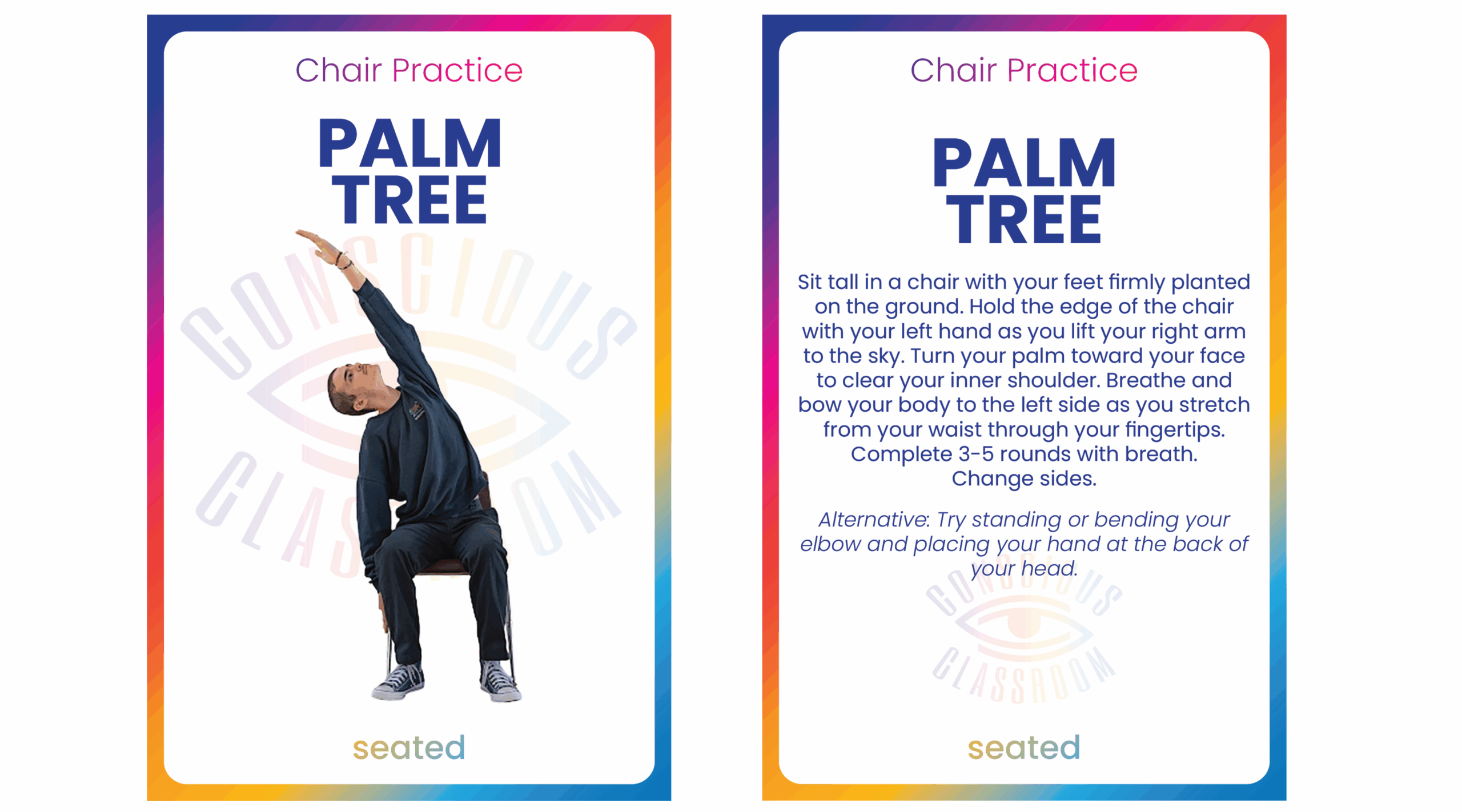
Palm Tree – Chair Practice
Practice aligning your mind and your body.