
Brain Science, Self-Regulation & You Week 5: Movement

Awake
Last week, we explored how self-regulation begins with understanding—recognizing when the brain shifts into survival mode and learning how the breath can help bring us back. This week, we take the next step. Because awareness alone is not enough. We must activate self-regulation in our brains.
Aware
Self-regulation isn’t just something we think about—it’s something we do. Every day, through small, intentional choices, we actively shape our brain health. The brain is your house—and you are its caretaker.
When the brain feels safe, we can move out of amygdala-driven reactivity and into the prefrontal cortex—the part of the brain responsible for thoughtful decision-making, focus, and self-regulation.
But this shift requires awareness. Start by noticing your thoughts. When automatic negative thoughts (ANTs) arise, pause and ask:
- Is this thought true?
- Can I know it to be a fact?
- How does this thought make me feel?
- Who would I be without this thought?
This is how we begin to reframe and rewire the brain—through conscious attention and reflection.

Align
Once we are aware, we can begin to align the brain and body. Alignment happens when we support the nervous system through consistent, foundational practices:
- Fuel & Hydration:
Your brain depends on what you give it. Proper nutrition fuels cognitive function, while hydration supports clarity, focus, and emotional balance. Even mild dehydration can impact mood and attention. - Dopamine & Discipline:
The brain’s reward system is shaped by repetition. Small, consistent actions—like journaling for a few minutes each morning—build motivation from within, rather than relying on constant external stimulation. - Sleep:
Sleep is essential for restoration. It supports memory, clears mental clutter, and resets the nervous system. Without it, regulation becomes significantly harder.
When we align these systems, we create the conditions for the brain to function at its best and activate.

Activate
And now—movement.
Movement is one of the most powerful and immediate ways to regulate the brain and body. It releases built-up stress, increases oxygen and blood flow, and helps bring the nervous system back into balance. It quite literally helps the brain reset.
When students (and adults) move, they:
- Discharge excess energy from stress responses
- Improve focus and attention
- Increase access to the prefrontal cortex
- Support memory and learning
Movement doesn’t have to be big to be effective. Practice this:
- Take a quick movement break—stretch, stand, or walk
- Pair hydration with movement (a walk to refill water becomes a reset moment)
- Build in short, intentional pauses throughout the day
Small actions, done consistently, create lasting change.
Remember, self-regulation is not a single strategy—it’s a system.
Awareness helps us notice.
Alignment helps us reset.
Activation helps us move forward.
And when we model this for our students, we show them that regulation is not about perfection—it’s about practice.

Activate Practice of the Week
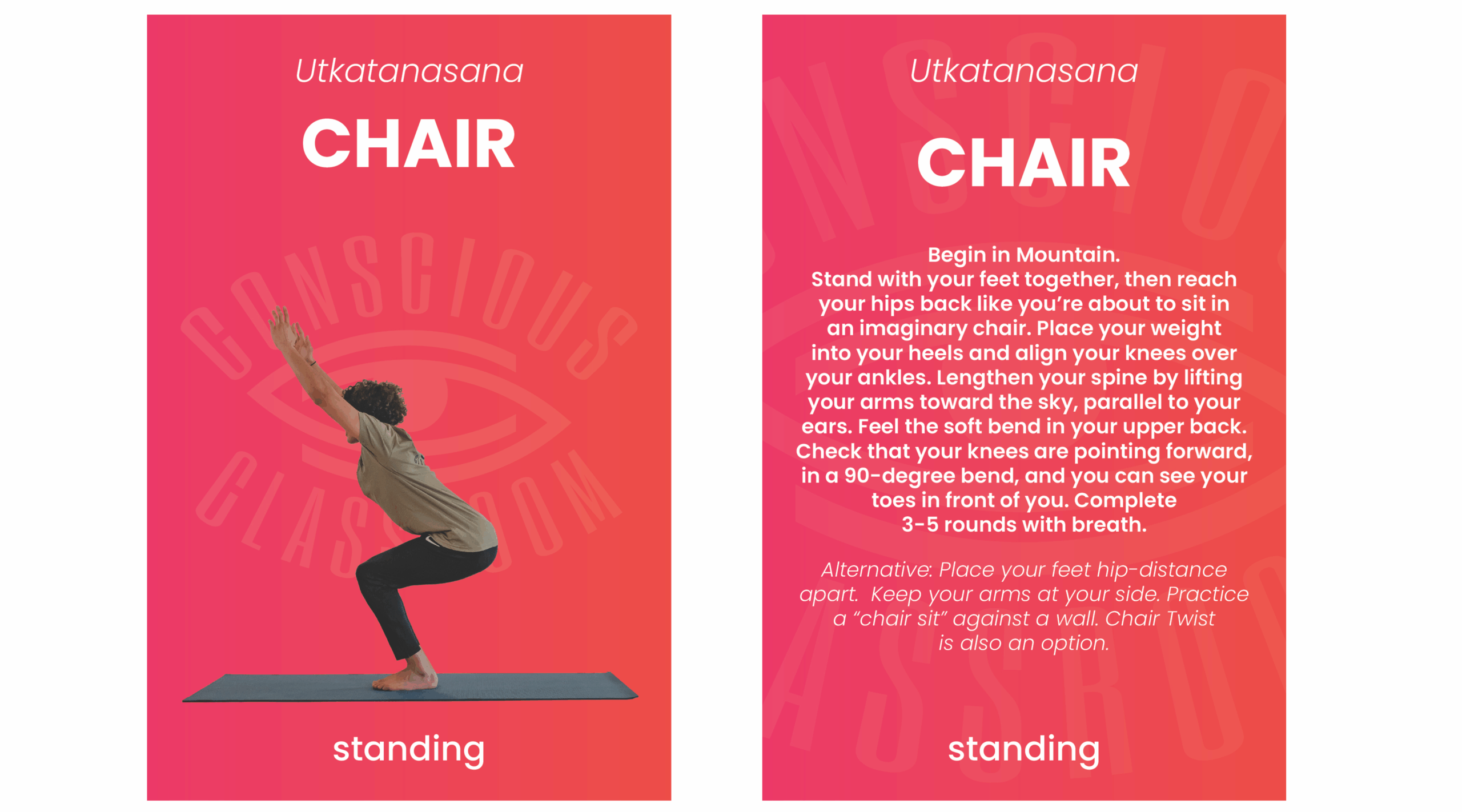
Chair Pose
Let’s practice!
Chair is an active pose that helps discharge excess energy while building strength.
Why it works:
- Engages large muscle groups → helps release stress hormones
- Requires focus and control → brings attention into the present moment
- Great when students are restless or dysregulated with too much energy
Take time to integrate movement into your classroom today! Try practicing with your students for two to three rounds.