
Brain Science, Self-Regulation and You Week 3: Mirroring Behavior in the Classroom

Awake
Self-regulation begins with understanding. When students learn what’s happening in their brains during moments of dysregulation, they gain the power to respond with intention rather than react on impulse.
Anger, panic, and shutting down are not “bad behavior”—they are signals. They tell us the brain and body have shifted into survival mode. By demystifying the brain, we help students make sense of their experiences and begin to take ownership of their actions.
Aware
In moments of dysregulation, the amygdala—our brain’s alarm system—takes over. It activates the sympathetic nervous system, triggering the fight-or-flight response. This response is designed to keep us safe, but it limits access to higher-level thinking.
At the same time, the prefrontal cortex—our “higher mind”—goes offline. This is the part of the brain responsible for focus, decision-making, impulse control, and emotional regulation.
When students understand this shift, they can begin to recognize it: “My brain is in survival mode right now.” Awareness is the first step toward change.

Align
Once we notice what’s happening, we can begin to shift it.
The most accessible tool we have is the breath. Slowing down the breath sends a signal to the nervous system that we are safe. It creates space to pause, observe our thoughts, and question what is true in the moment.
As the breath steadies, the nervous system begins to move out of the sympathetic (survival) state and into the parasympathetic (rest and regulate) state. This is where alignment happens—where the brain and body come back into balance, and the prefrontal cortex starts to come back online.

Activate
With a sense of safety restored, we can take intentional action.
Conscious breathing, counting inhales and exhales, and slowing the body’s pace all support regulation. Movement also plays a key role—helping to release stress and increase oxygen and blood flow to the brain.
This supports the hippocampus, a region critical for learning and memory. When students are regulated, they are better able to process experiences, retain information, and reflect on what they’ve learned.
From this place, students can think clearly, make thoughtful choices, and engage more fully in their learning. Let’s practice!

Activate Practice of the Week
Mountain Pose & Sun Salutation A
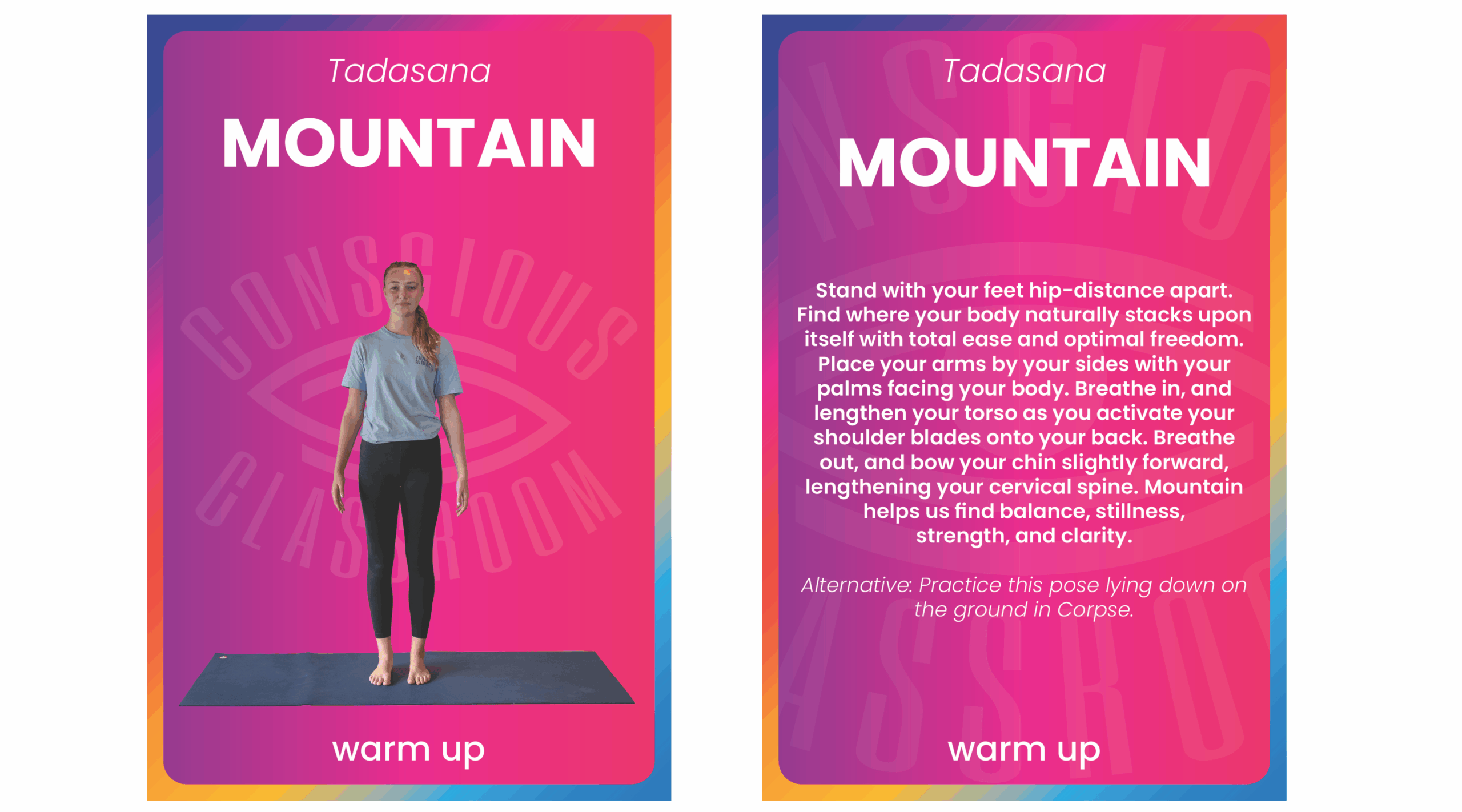
Mountain is perfect for slowing the breath down and observing from the inside out! In a classroom or daily setting, it’s almost like a “pause button”: Nothing to perform—just notice, breathe, and arrive. Even 30–60 seconds can settle energy, improve focus, and reduce reactivity!

Sun Salutation A is a powerful bridge between stillness and movement—teaching the body and breath to move as one continuous rhythm. Each posture is linked to an inhale or exhale, anchoring attention in the present moment, regulating the nervous system through rhythm, and building coordination between body + breath. Perfect for the classroom!